Joseph Hui ’89: Coming Full Circle at SFSU
After finding opportunity and encouragement at SFSU, one alum returns to offer the same to today’s students.
(Editor’s Note: Joseph Hui’s story is one of inspiration, achievement and happiness overcoming adversity and self-doubt. Growing up as a foster child, he was passed from foster home to foster home, along the way building and harboring doubts about himself. It was as a teenager when he encountered several people who recognized the potential in him that he turned his frustration and anger around, using it to lift himself up, ultimately making his way to San Francisco State University before earning a bachelor’s in Computer Science in 1989 and going on to a successful career as a software engineer.
Today, he gives back, teaching Computer Science courses at SFSU, mentoring students and encouraging them to find their inner strength.
Joseph’s story is inspiring. It reflects his powerful belief that good wins out, that people in need can excel if given the opportunity and guidance along the way.
Joseph entered SFSU through its Educational Opportunity Program that supports low-income and first-in-their-family students. It provides students in need with opportunity, resources, services and encouragement to rise above life’s challenges and set out on a path that leads to success.
He recently wrote an account of his SFSU EOP experience, excerpts of which are shared here to shed light on how the program benefits students.)
My SFSU EOP Story
By Joseph Hui (B.S., Computer Science, ’89)
My parents immigrated from Hong Kong in the early 1960s and I was born shortly after they arrived and was raised in Stockton, California. Growing up, my family faced significant mental health challenges, which eventually resulted in my brothers and me in foster care at a very young age.
As a young child, I thought that growing up in government dormitories and various foster homes was “normal.” After years of moving between placements, I was fortunate enough to be placed at the age of 12 with a stable and loving foster family until emancipation (the age when a youth legally leaves the public child welfare system upon reaching adulthood). Thank you, Max and Barbara Benitez. Foster youth often experience, at an early age, trauma that many people never encounter, and through those difficult years, I learned it truly takes a village to help raise a foster youth.
Academically, I was an A student through elementary and middle school. However, as a teenager, my awareness of my family’s socioeconomic circumstances began to affect my outlook on life and as a result, affected my academic performance. My realization of my social status took a toll on me and the weight of it resulted in my academic performance declining sharply in high school, where I barely graduated, even failing English. I then spent two years at Stockton's community college, San Joaquin Delta College, trying to move forward while struggling with my unresolved issues from childhood. I had a tough time completing courses, and most of the units I completed were non-academic, primarily in tennis and other PE classes.
A turning point in my life came when my brother, Karl, then a law student at UC Hastings, encouraged me to leave Stockton and move in with him in San Francisco. He did not have much saved up financially, but he refused to watch me continually proceed down a difficult path. After hearing about my struggles at the community college, he urged me to move to San Francisco and apply to San Francisco State University to continue my education. I applied in December 1982 for the spring 1983 semester, which was a decision that became a cornerstone of my life. Thank you, Karl, for that opportunity!
I entered SFSU through the Educational Opportunity Program (EOP) with low self-esteem, little confidence, and limited trust in others, which, unfortunately, are common challenges among former foster youth. At the time, I rarely thought about the future. But at SFSU, the EOP staff and my instructors were incredibly caring, empathetic, and helped me grow. Being hired as a tutor in EOP became another pivotal moment. My supervisor, Earlene Frierson, was welcoming, patient and incredibly supportive, putting up with my many antics. More importantly, she helped me feel accepted and spent time mentoring me, which made a lasting impact.
Experiences like these at SFSU taught me that compassion can change lives. At SFSU and EOP, I began to realize that my childhood did not define me. I stopped blaming my past for my setbacks and started to see my past experiences as a source of strength. I began taking responsibility for my future and changed my responses to challenges, which became an important turning point in my life.
In fall 1983, I met Mimi Yee (B.S., Biology, ’88) in the “Old Science Building.” I still remember seeing her for the first time outside of Chemistry 114 - Lab, and thinking, “Wow.” I was so nervous talking with her that my chemistry lab goggles would constantly fog up, which is something that Mimi still reminds me of to this day. It was a difficult time in my life, and I still don’t know what she saw in me, but she believed in me before I believed in myself. She is the most understanding and loving person I’ve ever known and as a result, more than 42 years later, she still remains the most important person in my life. We married in 1987 and have two wonderful children, Sandra, now 32, and Theodore, 24.
“At SFSU, the EOP staff and my instructors were incredibly caring, empathetic, and helped me grow. Experiences like these at SFSU taught me that compassion can change lives. At SFSU and EOP, I began to realize that my childhood did not define me. [...] I began taking responsibility for my future and changed my responses to challenges, which became an important turning point in my life.”
—Joseph Hui (B.S., Computer Science, ’89)
During my time at SFSU, I also met other people who deeply influenced my academic and professional journey. Kingman Yee, a graduate student and physics lab instructor, made me feel welcome and accepted, even though I couldn’t get into his full section. His easy-going demeanor left a lasting impression, and we became friends and still keep in touch.
Several years later, Harry Wong, an assistant professor in Computer Science, also played a pivotal role in my career. After I took his graduate database courses, CSC 730: Database Design and CSC 890: Topics in Hardware/Software Systems, he gave me the opportunity to join Ashton-Tate as a software engineer, which became my entry point into the software development industry.
My career was built on the strong foundation in Computer Science that I gained at SFSU. I began at Ashton-Tate working on dBASE IV Server Edition with connectivity to Sybase's SQL Server. After several years, I joined Sybase, where I progressed from the front-end porting group to the SQL Server Development - Kernel Group, over 6 years. From that experience, I went on to OnDisplay during the dot-com boom (woo-hoo, an IPO!), continued to a couple of failed startups, and then spent the last 20 years of my career at PeopleSoft/Oracle. Throughout my 35 years in software, the memories of my struggles in my childhood gave me the motivation to work as hard and smart as I could in order to provide for my family.
“My career was built on the strong foundation in Computer Science that I gained at SFSU.”
—Joseph Hui (B.S., Computer Science, ’89)
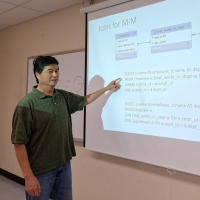
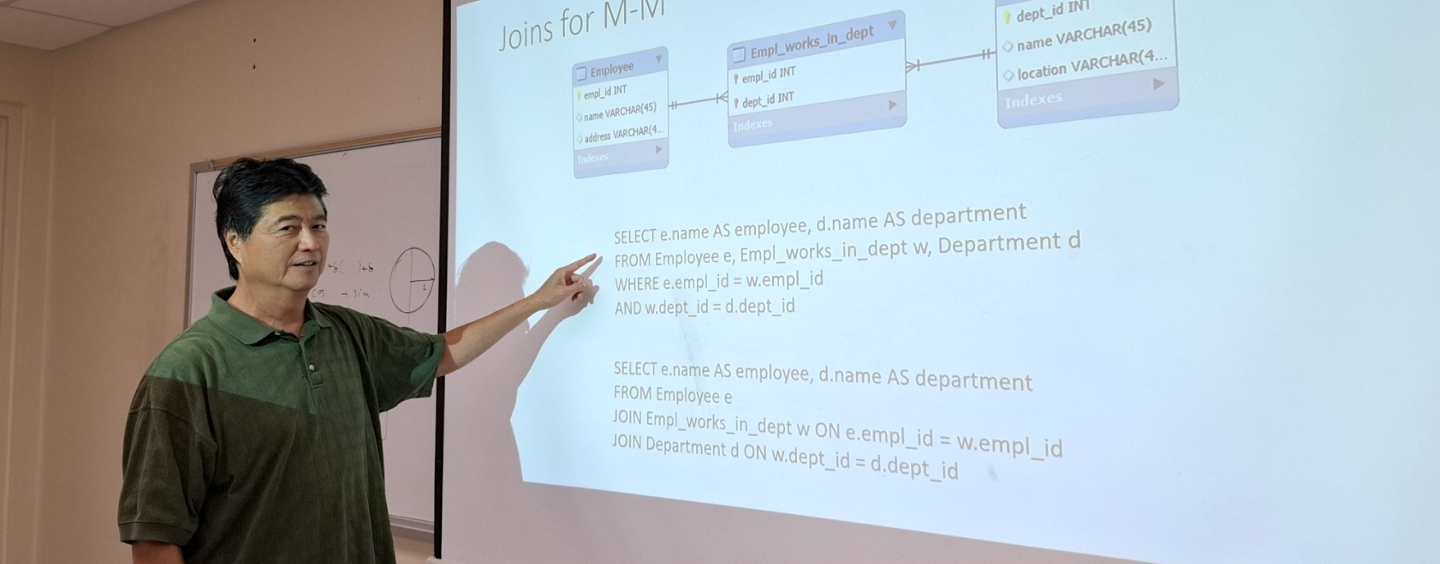
Because SFSU had such a profound impact on my life, I often returned to campus over the years to volunteer at Hackathons, Student Project Showcases, Computer Science Department functions and other student activities to contribute back to SFSU. During these visits, I frequently connected with our Computer Science Department Chair Arno Puder. In 2024, Arno gave me the opportunity to lecture on Relational Database Systems (RDBMS) and I eagerly accepted the opportunity to formally give back to the SFSU community.
In my retirement, I still lecture in the Computer Science Department, teaching senior/graduate-level courses, CSC 675/775: Introduction to Databases and CSC 641/841: Computer Performance Evaluation, much like my mentor, Harry Wong, did. I genuinely enjoy working with the next generation of software professionals and helping them prepare for careers in the software industry. Many of my students tell me that I give them hope and that they can tell that I truly care for their future success. I continually try to do my part to contribute to the success of our students and the SFSU community in as many ways as possible.
“I genuinely enjoy working with the next generation of software professionals and helping them prepare for careers in the software industry. Many of my students tell me that I give them hope and that they can tell that I truly care for their future success. I continually try to do my part to contribute to the success of our students and the SFSU community in as many ways as possible.”
—Joseph Hui (B.S., Computer Science, ’89)
Beyond teaching, I remain committed to giving back in other ways. I have volunteered for over 20 years at the Adopt-A-Family Bikes program, where we accept donated bikes from our local community and clean, fix, safety check, and then distribute the bikes with new helmets and locks to people in need. Over the years, we have distributed over 6,000 bikes.
My favorite bike recipients are the students in SFSU's Guardian Scholars Program (GSP), which supports former foster youth. Nationally, only a small percentage of former foster youth graduate from a four-year university (~4-5%), although newer research suggests it may be closer to 10%. Either way, the odds are challenging for former foster youth. In contrast, GSP graduation rates are much higher (over 80%) thanks to comprehensive support such as year-round housing, financial guidance and tutoring. Programs like GSP are invaluable to former foster youth and I often wish GSP had existed when I was a student at SFSU.
I also serve on the Board of Directors for El Concilio, an organization founded by my foster father, Max Benitez, in 1968. The organization supports low-income, minority and marginalized people in the Central Valley with outreach, education, engagement, counseling, job training, childcare facilities, legal help and advice on interacting with various government agencies. We provide over 1,000 meals daily and host regular food drives. It is an honor to contribute to Max's legacy.
“[Guardian Scholars Program] graduation rates are much higher (over 80%) thanks to comprehensive support such as year-round housing, financial guidance and tutoring. Programs like GSP are invaluable to former foster youth and I often wish GSP had existed when I was a student at SFSU.”
—Joseph Hui (B.S., Computer Science, ’89)
The education and wonderful people and programs at SFSU were an instrumental part in my life (remember the village!). It's difficult to imagine where I would be without SFSU, but I know that I would not be as fulfilled nor successful. The SFSU EOP community is comprised of people with the best frame of mind to help our students. The education and knowledge SFSU provides is very important, but the empathy and caring from our staff and instructors provide so much more, which is the best part of the California State University system.
For prospective students, I want them to see that SFSU is much more than simply a “safe” school for admission. Rather, it is an inclusive university that gives students from a wide range of backgrounds the opportunity, support and resources to realize their potential. My experience with SFSU and EOP is a great example of that.
“It's difficult to imagine where I would be without SFSU, but I know that I would not be as fulfilled nor successful. The SFSU EOP community is comprised of people with the best frame of mind to help our students. The education and knowledge SFSU provides is very important, but the empathy and caring from our staff and instructors provide so much more, which is the best part of the California State University system.”
—Joseph Hui (B.S., Computer Science, ’89)
For potential donors, I hope my story illustrates the very real impact their contributions can have. People often give back to their alma mater because of what the institution meant to them personally. SFSU may not always receive the recognition of more prestigious universities, but that does not diminish the profound impact it has had, and continues to have, on the lives of so many of our students.
Even now, twice a week as I cross the Bay Bridge to teach, I find myself smiling, grateful for the opportunity to give back, however small, to the SFSU community that gave me so much.
“SFSU is an inclusive university that gives students from a wide range of backgrounds the opportunity, support and resources to realize their potential. My experience with SFSU and EOP is a great example of that.”
—Joseph Hui (B.S., Computer Science, ’89)
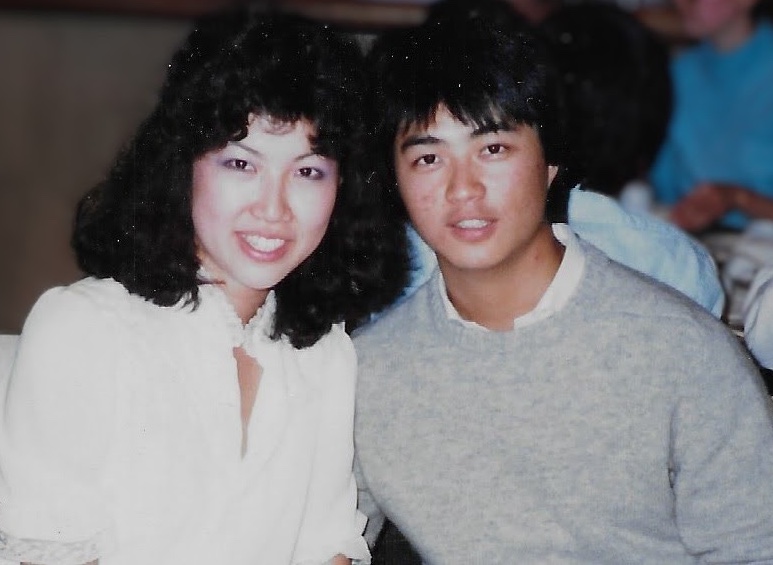
Joseph Hui met his wife, Mimi Yee, when they were both SFSU undergraduates.
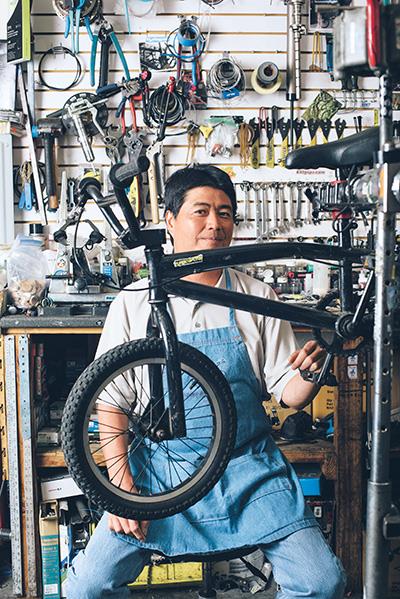
Joseph has volunteered for over 20 years at the Adopt-A-Family Bikes program, which accepts donated bikes from the local community and then restores and distributes the bikes with new helmets and locks to people in need. In 2016, Joseph was honored as a Threads of Hope Award Winner by Diablo Magazine, which annually “recognizes an amazing group of volunteers who go above and beyond to make the East Bay a better place,” for his work with Adopt-A-Family Bikes. Photo courtesy of Diablo Magazine.
For more information about the Educational Opportunity & Pathway Programs (EOPP), contact:
Anjali Billa
Interim Vice President
University Advancement and Comprehensive Campaigns
President
SFSU Foundation
anjalibilla@sfsu.edu
(415) 405-3625
Tags
Related News