Gillis Lowry: Searching the Stars for Life Beyond Earth

Scholarship support is helping an SFSU astronomy graduate student advance the search for habitable worlds beyond our solar system.
Coincidence can be a very funny thing. Sometimes, it’s a bit of a one-off, like finding out that you have the same birthday as a new friend, a distant relative or a prominent historical figure. Other times, it could mean something altogether different, as if the stars have aligned to indicate that you are exactly where you are supposed to be in life and career.
SFSU astronomy graduate student Gillis Lowry is living one particular coincidence that falls into both categories.
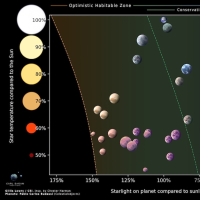
Lowry is the co-author of a widely publicized scientific paper that tries to answer the question of which of approximately 6,000 discovered exoplanets (planets outside of our solar system) are the most likely to have some form of life. “Probing the Limits of Habitability: a Catalogue of Rocky Exoplanets in the Habitable Zone,” published March 19 in the prestigious Monthly Notices of the Royal Astronomical Society, helps to narrow the search to 45 exoplanets, enabling astronomers to focus their research on the planets most likely to answer the question of if we are alone in the universe.
We’re not talking about little green men (or women) here. Microbial life is the most likely candidate to be discovered, at least at this point in planet Earth’s ability to search the cosmos. Whatever form of life may (or may not) be found, Lowry seems to have been both destined and determined to be right where she’s at. She’s clearly focused on where she wants to go, and making her journey possible is the financial support she has earned as a recipient of SFSU’s Kazuko Walson Scholarship.
“Scholarships are very vital to allowing people to continue to work in astronomy because it is not a lucrative field, especially not while you're in the very early career stages,” said Lowry, who also was awarded the Achievement Reward for College Scientists (ARCS) 2026-27 Scholarship, and was a finalist in the recent CSU Student Research Competition.
“I would like to thank San Francisco State University and everyone who helps make it what it is,” Lowry said. “I'm very grateful for the chance to continue to stay in this field and to continue to improve my skills and bring me closer to the career I hope to have in astronomy research and science communication.”
With a bachelor’s degree in Astronomy from Cornell University, Lowry plans to go on to study for her Ph.D. with the goal of continuing research on habitable worlds beyond our own while adding public communication to her career path.
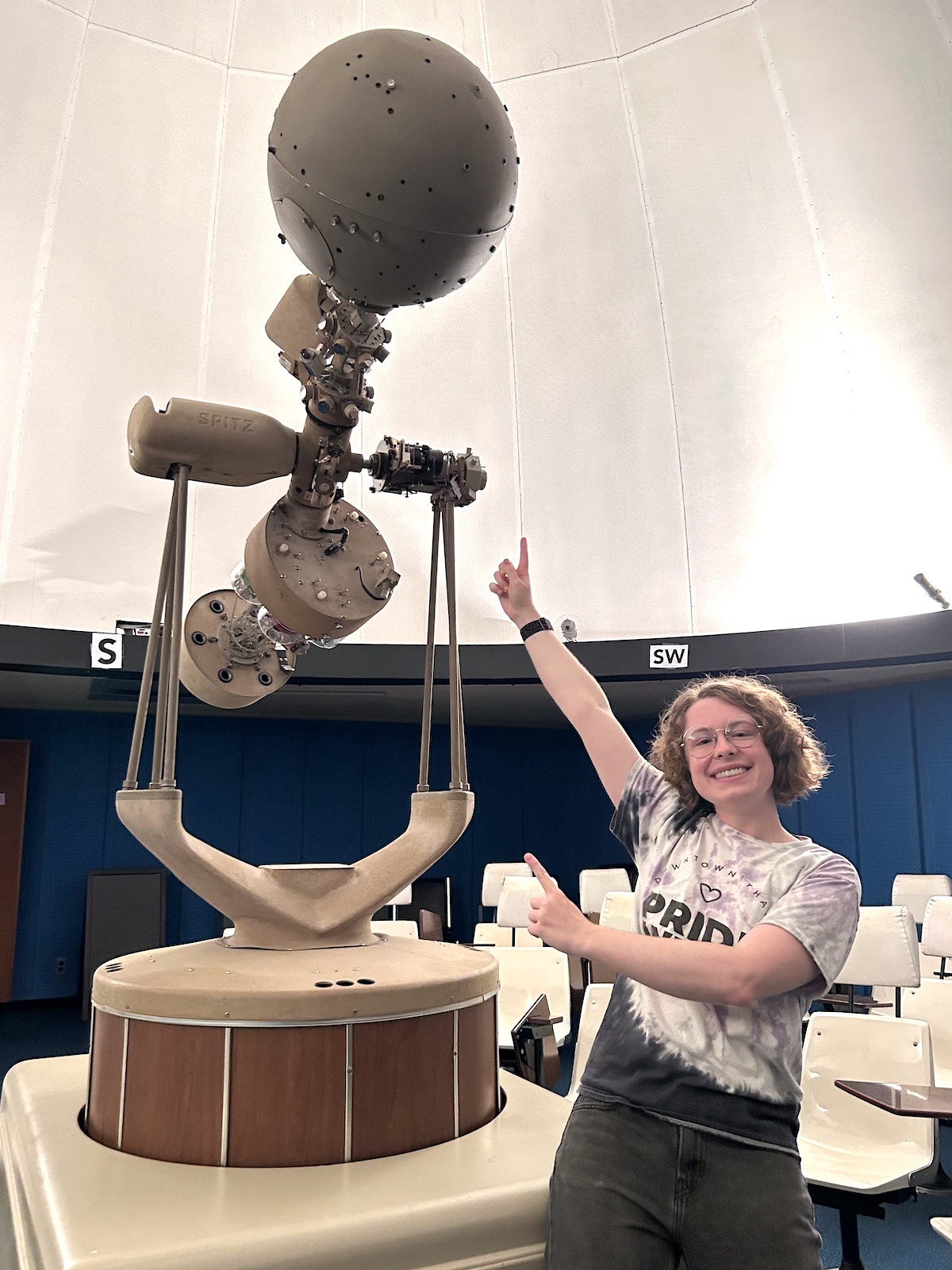
Gillis Lowry standing next to the SFSU Charles Hager Planetarium's old projector.
“I would like to thank San Francisco State University and everyone who helps make it what it is. I'm very grateful for the chance to continue to stay in this field and to continue to improve my skills and bring me closer to the career I hope to have in astronomy research and science communication.”
—SFSU astronomy graduate student Gillis Lowry on donor-funded scholarships
“The master's program at SF State will allow me to continue doing research and also to take needed classes before I go to a Ph.D. program,” said Lowry, who co-authored the exoplanet habitability paper with Cornell University students Abigail Bohl and Lucas Lawrence and Professor Lisa Kaltenegger, director of the Carl Sagan Institute at Cornell.
“Our paper was mainly to create a target list of the planets that would be the most interesting to follow up with telescopes, especially future telescopes,” Lowry said. “I have a follow-up paper coming out probably in a year that's going to reveal how likely it is that we could observe these planets with the James Webb Space Telescope (JWST).”
But, just how do researchers such as Lowry, her co-authors and others determine which exoplanets may have life? Considering that the closest exoplanets to Earth are approximately 4.25 light years (about 25 trillion miles) away from us, getting any kind of reading on them might seem implausible if not downright impossible, at least to non-astrophysicists.
According to Lowry, the team’s research over three years was aided by telescopes such as JWST, data from the now-retired Gaia spacecraft of the European Space Agency (ESA) and reliance on trusted scientific methods to come up with their list of 45 exoplanets.
As Lowry explains it, “Scientists have a rough idea of the size and orbits of many exoplanets, but it’s difficult to determine whether these tiny worlds have an atmosphere, much less one that can support life. Sometimes, though, astronomers get lucky, and an exoplanet happens to orbit in front of its star from our perspective. As it does so, starlight passes through any atmosphere the planet has. Chemicals in the atmosphere can then absorb specific wavelengths, or colors, out of the starlight.”
She continues, “When we receive all the light in our telescope and we split it up into a full rainbow, we're able to see little lines that have been taken out of the rainbow. And because we've measured these chemicals on earth, we know what specific lines correspond to what specific chemicals. At that point, if it has something like methane or oxygen, especially if it has a few of those together, then we might be able to say there's far too much of this specific chemical for it to be present in this atmosphere without eventually getting blown away into space, unless life is continually producing it.”
Hearing Lowry enthusiastically explain the process, it sounds so relatively easy. Of course, it’s not, but her tone conveys the sense of how much she enjoys the research.
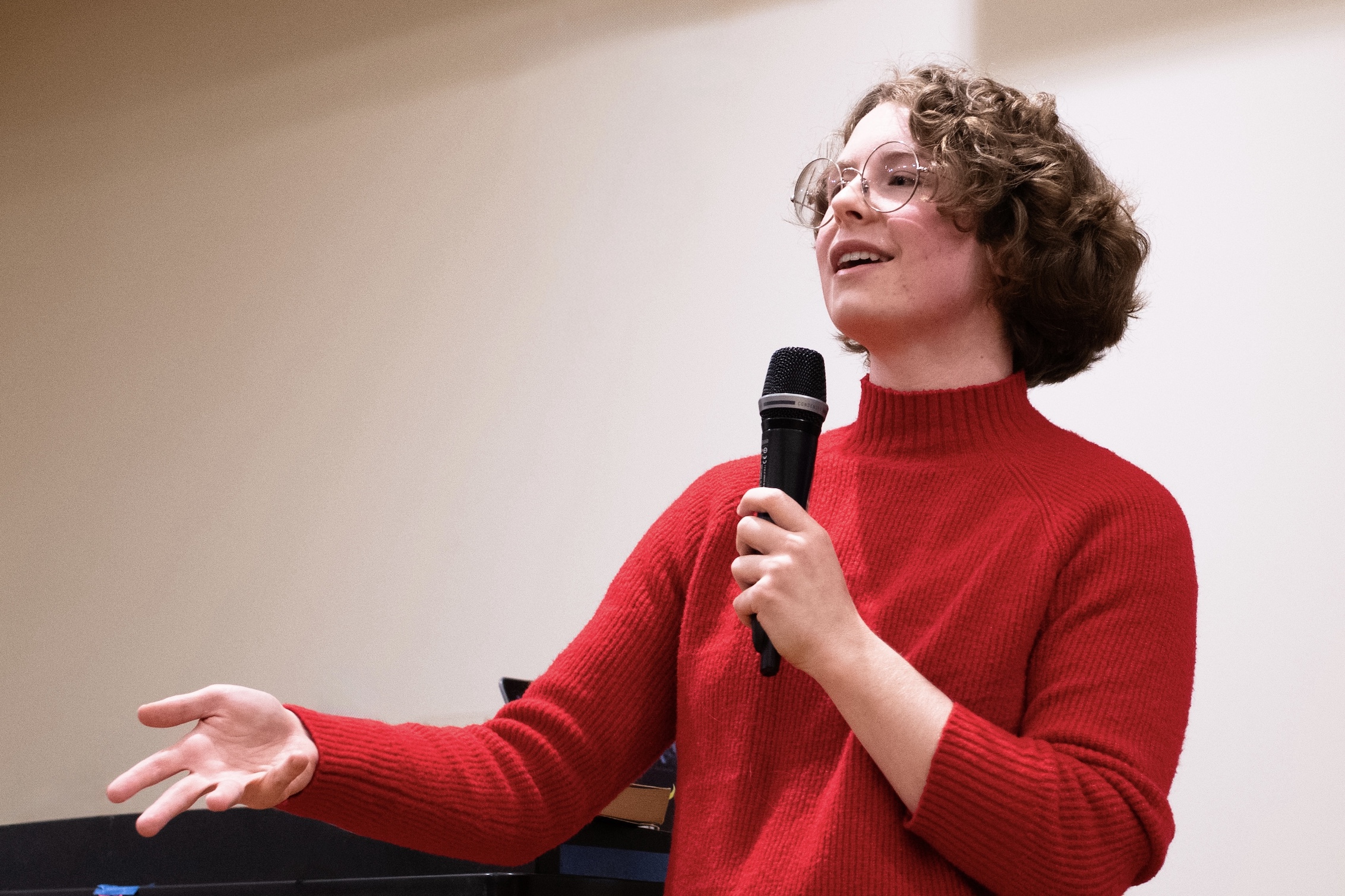
Gillis Lowry gives a talk about the search for life and the importance of science literacy
for Carl Sagan's 91st birthday.
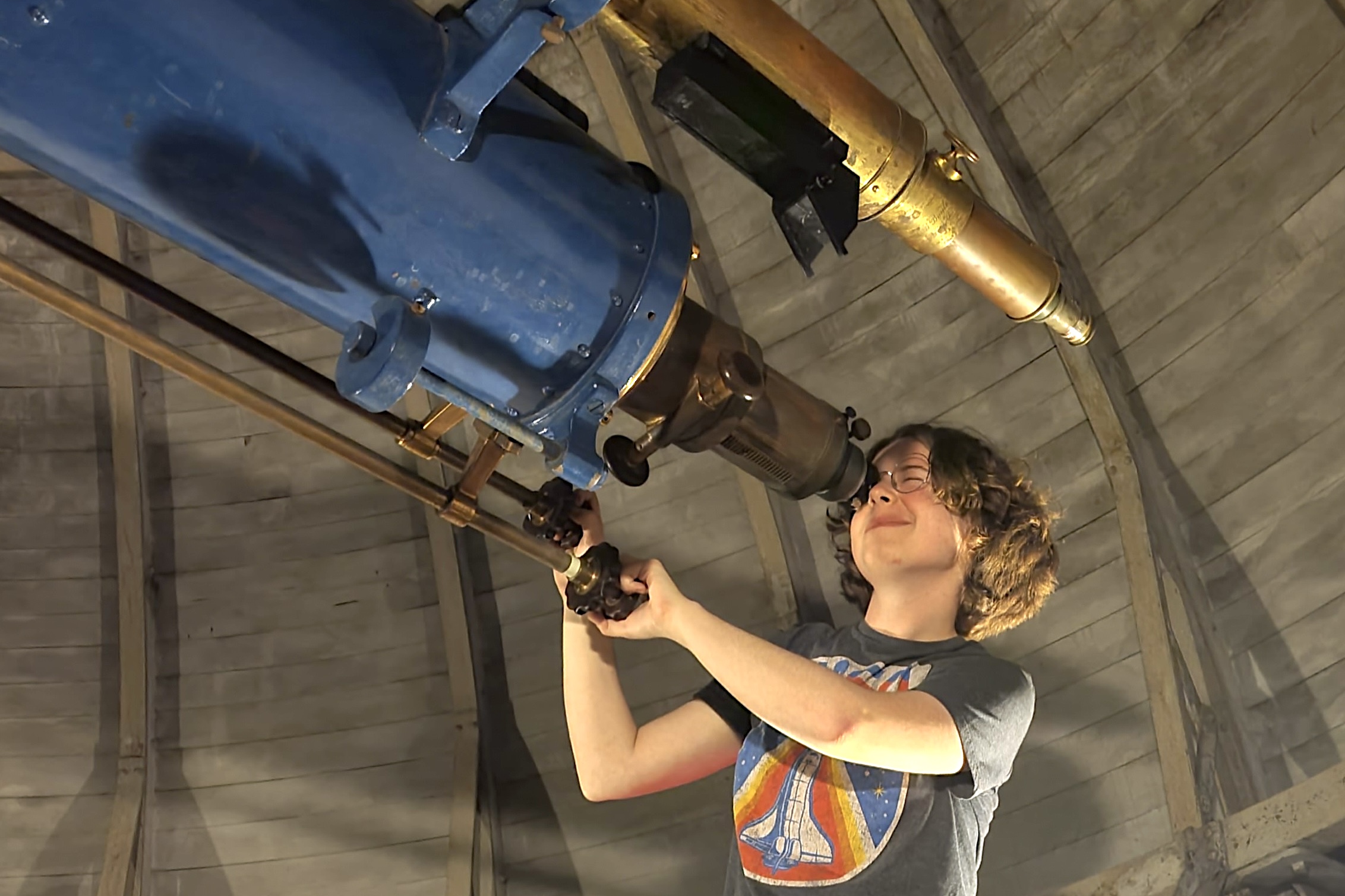
Gillis peers through the Irving Porter Church Telescope at
Cornell University's Fuertes Observatory.
To get a complete picture of Lowry’s pursuit of astronomy, we have to look back at where it all started. As a 6-year-old first grader, she was captivated by glow-in-the dark space books which she checked out her local library and would read under the covers at night. A year after that — and here’s where the profound coincidence comes in — she learned that she shares a birthday with legendary astronomer, author, TV host, and commentator Carl Sagan.
“I had never heard of him before, but I saw that he was an astrophysicist and an author,” Lowry said. “I really liked writing and I really liked space, so from then on I started saying that I wanted to be an astrophysicist when I grew up.” Later, she learned that Sagan was a professor at Cornell for 30 years. “That’s where my fixation on going to Cornell came from, because there were a lot of opportunities to uphold his legacy, both in terms of astronomy research and science communication.”
Growing up in St. Louis, a city with a rich history of supporting human space exploration with research and design and manufacturing of rockets as early as Project Mercury, Lowry took to astronomy like comets take to the cosmos. It was in St. Louis that Lowry “grew up going to the James S. McDonnell planetarium — even spending the night there under the stars.” She later returned there as an undergrad to present planetarium shows for up to 150 adults and children. Her experience giving shows there led her to jump right into giving shows at SFSU’s Charles F. Hager Planetarium.
As the Hager Planetarium is currently undergoing renovation that will include a state-of-the-art star projector with full dome video, Lowry will be spending most of her extracurricular time at SFSU working on a complete overhaul of astronomy lab curriculum with Professor Eileen Gonzalez, Professor Adrienne Cool and Astronomy Laboratory, Planetarium, and Observatory Technician Jim Gibson. “The updated planetarium will have so many new capabilities — flying through the canyons of Mars and zooming out to the farthest reaches of our observable universe, for example — as well as a more accurate, more beautiful night sky,” Lowry said. “I’m very passionate about upgrading the labs to be more engaging and to cover a wider spread of topics, so I’m devoting my time to making them the best they can be.”
“I’m very passionate about upgrading the labs to be more engaging and to cover a wider spread of topics, so I’m devoting my time to making them the best they can be.”
—SFSU astronomy graduate student Gillis Lowry
Lowry’s research will inform the scientific communication she aspires to continue, building upon the work she did while at Cornell that included publicizing the student-built spacecraft Alpha CubeSat, directing events honoring Sagan’s legacy and the search for life, writing articles and making videos for the Carl Sagan Institute, coordinating the 100th anniversary celebration for Cornell’s Irving Porter Church Telescope at Fuertes Observatory and more.
“I’m interested in writing, video creation and presentation of topics in front of a camera,” Lowry says. “Ultimately, it's getting feedback from the public and being able to talk to the public and interact with them directly that is really the most exciting part as well as getting to see people's reactions to space and how much awe it instills in them.”
About the Kazuko Walson Scholarship
(Ms.) Kazuko Walson (dec. circa 2003) was a Physics student at SFSU in the 1970s. Upon her passing, her estate contacted the Physics department to set up the scholarship in her name “to provide scholarships to students who need financial assistance to pursue their studies in either astronomy or space exploration.”
If you would like to consider a planned gift, an endowed scholarship or a one-time gift to assist students such as Gillis Lowry, please contact College of Science and Engineering Director of Development Holly Fincke at hollyfincke@sfsu.edu. You may also make a donation to support the renovation of the Charles S. Hagar Planetarium.
For more information about donating to the College of Science & Engineering, contact:
Holly Fincke
Senior Director of Development
College of Science & Engineering
(415) 338-7118
Tags
Related News